 |
Curt Flood (1938-1997)
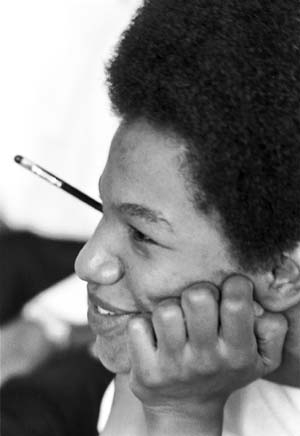
After Jackie Robinson, Curt Flood is the most important figure in the history of professional sports in the United States. Whereas Jackie Robinson was the man who integrated baseball, Curt Flood was the man who made it possible for all baseball players (and eventually, by extension, all professional athletes) to become free agents and thus have greater control over their labor.
Prior to free agency, baseball had something called the "Reserve Clause" in place. The Reserve Clause effectively (1) gave ownership exclusive rights over a player for the duration of his career (2) kept salaries perpetually low because players could not negotiate with multiple teams and (3) forced players into retirement or other extenuating circumstances if he could not come to an agreement with his club. The Reserve Clause always gave ownership the advantage over players.
When Mr. Flood challenged the Reserve Clause (he did so because at the end of the 1969 season, he was traded to Philadelphia against his wishes) he was doing something very uncommon for black athletes and especially rare for black baseball players: activism against the institution. As much as I love Hank Aaron, Frank Robinson, Ernie Banks, and Hank Aaron, none of these men really did as much for baseball (and other professional athletes) as Curt Flood. In fact, when Mr. Flood against Major League Baseball to the Supreme Court, no other active baseball player neither offered testimony on his behalf nor attended the trial. Maybe it's appropriate that Jackie Robinson was one of two retired players whom offered testimony (the other being Hank Greenberg).
Here was the outcome of the Supreme Court case of Flood v. Khun (as summarized in The Atlantic):
"In effect, the court ruled that yes, Flood should have the right be a free agent, but that baseball's antitrust exemption could only be removed by an act of Congress and that free agency for players should be attained through collective bargaining." In 1976, the Reserve Clause was eliminated when "when pitchers Andy Messersmith and Dave McNally agreed to play a season without a contract" and an independent arbitrator declared the players to be free agents. The direct results of this event were threefold: (1) baseball salaries sky-rocketed, (2) attendance and TV ratings also sky-rocketed because of increased fan interest due to free agency and teams' ability to acquire premium players, and (3) other professional sports followed-suit in terms of eliminating their versions of the Reserve Clause and instituting free agency; however, this story does not have a "happy ending" for its protagonist. Unfortunately for Mr. Flood, he never had an opportunity to benefit from free agency. After sitting-out for the entirety of the 1970 season, Curt Flood made his final Major League appearance on April 25, 1971 for the Washington Senators. During this time, Mr. Flood was despised by baseball fans and his fellow players for trying to "destroy baseball." Moreover, he received multiple death threats on a daily basis. Read this: "As Miller had predicted, Flood never benefited from the revolution he helped begin. High-strung and sensitive, Flood had been a heavy drinker practically since the time he became a professional ballplayer, and by the early 1970s he was an alcoholic. His first marriage fell apart in the mid-1960s from the combination of alcohol abuse, long stretches away from home, and the animosities his unwavering Civil Rights stance inspired. After the Supreme Court decision, he was bombarded with hate mail from fans who accused him of trying to destroy baseball; his teammate Bob Gibson estimated 'He got four or five death threats a day.'" It would be years after the emergence of free agency that Mr. Flood experienced the recognition that he rightfully deserved. Curt Flood sacrificed so much for his fellow professional athletes and he suffered alone. One of the special considerations about this story is the manner in which Mr. Flood really "put himself out there" when other baseball players (black and white) did not. The overwhelming majority of ball-players (and this is an especial consideration for black players who were only 20 or so removed from Jackie Robinson and were still experiencing discrimination in many ways) did not want to risk losing what they had, even in the face of blatantly unfair treatment. I respect Curt Flood so much for standing up and sacrificing a stellar career for what he believed in. Mr. Flood's actions have immensely benefited every American who enjoys any type of professional sport from athletes to fans to (ironically) owners and corporations. Yet how many of us know his name or are aware of his contributions? Could you imagine professional American sports without Curt Flood's contributions? Could you imagine the NFL, NBA, MLB, or NHL without free agency? I can't. |
Monday, February 6, 2012
BHM Profile #2: Curt Flood

Friday, February 3, 2012
BHM Profile #1: Ruby Doris Smith-Robinson
I want to do something special to celebrate Black History Month. A few days ago, I hinted in this blog entry that I was frustrated that a wider and more diverse array of black folk were recognized. And well, if I say this, then I have to do my part. This month, I am going to profile some of the black individuals and organizations whom efforts and contributions I believe to be understated. I'm just going to highlight amazing people from all walks-of-life and offer a few thoughts.
Ruby Doris Smith-Robinson (1942-1967)
(Please check out a good wikipedia about Ms. Ruby Doris Smith-Robinson here)
Raise your hands if you've heard of a group called SNCC - the Student Nonviolent Coordinating Committee. Now raise your hands if you're familiar with either John Lewis or Stokely Carmichael? How about this: How many of you have heard of Ruby Doris Smith-Robinson?
Before I took a class on the Black Power era in college, I had never heard of this awesome lady. And the reason I call her awesome is that she was really a "bad-ass" lady! As SNCC's first female Executive Secretary, she instituted a "jail, no bail" policy, which meant when a SNCC member was arrested in a demonstration, he or she would not be bailed. Prior, to the implementation of jail, no bail, older members of the black community would gather funds to post bail for jailed SNCC members, but eventually, this practice became burdensome for the community. Ms. Smith-Robinson's effort demonstrates true concern for the people and a spirit of sacrifice. Moreover, it would be one thing if she simply created and implemented this policy; however, she actually lived it. Read this:
If that isn't leadership, then I don't know what is.
It takes a special type of person to be able to work "behind the scenes." For everything that John Lewis and Stokely Carmichael did in the public sphere, I can imagine that Ms. Smith-Robinson had to do twice as much. She was the main logistical mind behind SNCC as well as an active participant in many of the sit-ins and freedom rides. I really don't think that Ruby Doris gets the credit or recognition that she rightfully deserves and this might be in large part due to the blatant patriarchy that existed within SNCC, particularly during Carmichael's leadership. In any case, I just want to say that I appreciate Ruby Doris Smith-Robinson's contributions and life.
 |
| "You could feel her power in SNCC on a daily basis" - Matthew Jones, SNCC Freedom Singer |
Ruby Doris Smith-Robinson (1942-1967)
(Please check out a good wikipedia about Ms. Ruby Doris Smith-Robinson here)
Raise your hands if you've heard of a group called SNCC - the Student Nonviolent Coordinating Committee. Now raise your hands if you're familiar with either John Lewis or Stokely Carmichael? How about this: How many of you have heard of Ruby Doris Smith-Robinson?
Before I took a class on the Black Power era in college, I had never heard of this awesome lady. And the reason I call her awesome is that she was really a "bad-ass" lady! As SNCC's first female Executive Secretary, she instituted a "jail, no bail" policy, which meant when a SNCC member was arrested in a demonstration, he or she would not be bailed. Prior, to the implementation of jail, no bail, older members of the black community would gather funds to post bail for jailed SNCC members, but eventually, this practice became burdensome for the community. Ms. Smith-Robinson's effort demonstrates true concern for the people and a spirit of sacrifice. Moreover, it would be one thing if she simply created and implemented this policy; however, she actually lived it. Read this:
"On February 1961, students used the "jail, no bail" tactic, serving jail for 30 days after getting arrested in Rock Hill, South Carolina for participating sit-in of honoring the anniversary of Greensboro. Once she joined the Freedom Riders, she immediately took part of a ride that was going from Nashville, Tennessee to Montgomery, Alabama in May 17, 1961. However, she was violently attacked and was beaten in Montgomery, and was arrested in Jackson, Mississippi for traveling inflammatory. After the arrest, She used “jail no bail” by accepting 45 days in Parchman State Prison"
If that isn't leadership, then I don't know what is.
It takes a special type of person to be able to work "behind the scenes." For everything that John Lewis and Stokely Carmichael did in the public sphere, I can imagine that Ms. Smith-Robinson had to do twice as much. She was the main logistical mind behind SNCC as well as an active participant in many of the sit-ins and freedom rides. I really don't think that Ruby Doris gets the credit or recognition that she rightfully deserves and this might be in large part due to the blatant patriarchy that existed within SNCC, particularly during Carmichael's leadership. In any case, I just want to say that I appreciate Ruby Doris Smith-Robinson's contributions and life.
Wednesday, February 1, 2012
What Does Black History Month Mean To Me?
What does Black History Month Mean To Me?
A lot...
A lot...
In the broad, overarching sense, black history is at the core of American history. One could not tell the story of America without featuring black folk as essential players i.e. their contributions, struggle, and ultimately perseverance; however, this country's history has been told without giving African Americans due credit. When historian Dr. Carter G. Woodson established "Negro History Week" back in 1926, he noted that blacks' contributions to American history "were overlooked, ignored, and even suppressed by the writers of history textbooks and the teachers who use them." It's in Dr. Woodson's original purpose, to better acknowledge the richness of black contributions to our country, with which I most agree and value. Furthermore, it's essential that kids are able to learn about who they are and the deep legacy which they inherit.
When I was in elementary school, I couldn't really appreciate black history because it was framed as a story of "victimization." Looking back on my early encounters with my history as it was taught in public schools, the lack of detail or multiple perspectives greatly hampered my outlook; I thought black history was embarrassing (it pains me to type these words). Think about it like this; I would summarize my early understanding of black history in three statements:
1. Black people were slaves to white people.
2. Black people were segregated from white people and were treated unfairly.
3. Dr. Martin Luther King Jr. came around and made everything better; now we're all equal.
I also learned about other historic African American figures such as Harriet Tubman, Frederick Douglass, Booker T. Washington, Jackie Robinson, and Rosa Parks. Basically, I was taught about who these people were, the obstacles they faced/overcame, and their contributions to black people... not American society overall, but just black people (that was the way it felt). After February, it felt as though these folks either disappeared as their posters were taken down or I wouldn't hear about them again until next year. A lot of this exposure to African American history felt like "lip service," but at home, it was definitely a different story.
My parents grew up totally in blackness. Both my mother and father grew up in a racially divided 1960s and 1970s Washington D.C. and lived a lot of what I was learning in school. I remember my Dad telling me about seeing Dr. King in church as a little boy or my mother mentioning how she used to see James Brown in the Howard Theater for a Saturday afternoon matinee show (mind-blowing). My parents knew about the watered-down version of black history taught in my school and attempted an intervention of sorts by trying to teach me more, but I wasn't ready. At a young age, I wasn't ready to absorb and understand the complexity of the black experience - the pain or the joy.
It wasn't until I participated in the W.E.B. DuBois Scholars Institute (essentially a nerd summer camp for minority scholars with an emphasis on African American history) in 2004 that I truly began to study and really appreciate black history. At this time, I was more mature and ready to take in the complexity of blackness. I enjoyed learning about different, and in my opinion, more interesting black historical figures including W.E.B. DuBois, Ida B. Wells, and of course Malcolm X. It was at the Institute that I learned that a people's history can be tragic in the atrocities, yet beautiful in the perseverance and triumphs.
Today, I have a more favorable opinion of Black History Month. I am glad that it exists in that it increases awareness, but agree with the popular sentiment that by no means should the study or celebration of black history be limited to a single month; it needs to be an ongoing process. I hope that schools don't stop (or decrease) exposing kids to black history because it's no longer February. Also, I deeply dislike how commercialized this month has become - just look around.
If I had one wish for the future of Black History Month, it would be this: More exposure for the efforts of some of the less recognized figures of African American history - that would be great!
 |
| Believe it or not, my favorite historic African American figure to study is the first black World Heavyweight Champion Jack Johnson: his story is deep. |
Monday, January 30, 2012
Happy Birthday Jahnabi!
 |
| Remember this Intercession trip from four years ago? Great times with great folks! |
I'd just like to take a moment to wish a Happy Birthday to one of my favorite individuals in the entire world.
Happy Birthday Jahnabi: If I could send you a birthday package, it would be full of smiles, great memories, and even better moments to come. I am so happy and thankful to have you as a friend... and really, you're the most positive person I know.
Have a great day Jahnabi; you deserve it!
- Reg
Friday, January 27, 2012
5 Things to Consider when Selecting an Eating Club
It's that magical time of the year isn't it? The first semester is wrapping up and sophomores are deciding which eating clubs to join! I originally created this Facebook note last January, but the information here is still relevant; however, I would add three more items: (1) it's totally cool not to join an eating club, (2) If you're thinking about bickering, go for it! Don't overthink it, just be yourself!, and (3) don't sleep on Quad - I'll have more to say about that later on today.
Three years ago, I joined Quad because, I felt comfortable with it's senior class/officer corps, I had junior friends in the club, and my good buddy S from Forbes was signing-in as well... that was the best decision I made in the course of my Princeton career. I hope this note helps :)
1. Join the club in which you feel the most at home: As an upperclassman, the a significant portion of your time will be spent at the eating club that you decide to join - for the next two years, you will have most of your meals in one location. It is a good idea to make sure that you're comfortable with almost very aspect of the club, especially the membership and food. Additionally, be sure to consider the additional facilities - i.e. hangout spots, study locations, computer labs, etc. One more thing: your club is going to be the first place you come back to as an alumni...
2. There are pro and cons to joining the same club as your friends: A lot of people decide to join the same club as their friends (when I say friends, I'm talking about a group of 3-4 people) - there are both positives and negatives aspects to this process. Pros: joining the same club as your friends ensures that you'll regularly have a core group of people to eat with and (in my opinion) this is especially desirable in certain clubs. Con: Joining a different club than your core group forces you to interact with new people and thus make new friends. Keep this in mind, with meal exchanges as a junior or senior, you will be able to eat at any club in which your friends are members at almost any given meal.
3. Look out for the club's officer corps: An eating clubs' officer corps is responsible for taking care their members, i.e. you. Ideally, as a member, you'll want to join a club whose officers are friendly, visible in the club, accessible, and receptive to your concerns/criticisms. Ultimately, the officers are the individuals that are responsible for the operation and direction of the club, including the food, parties, formals, dues and a multitude of other factors - they are the people you'll need to go to if you'd like to see any change in your club.
4. Before you sign-in or bicker, do your best to learn about "sophomore status" within your club: In general, sophomore dues total up to be a few hundred dollars and a limited number of meals each week; however, the dues and sophomore membership benefits vary from club to club. For instance, certain clubs may allow sophomores to bring guests to houseparties whereas other may not. Just as a rule of thumb, I think it's a good thing to know what your getting for your money - you might even decide to delay your membership until junior year (which is practical for some clubs more than others).
5. It's cool to change your mind: In the world of eating clubs, nothing is permanent. It's cool to join a club sophomore year and reconsider your options come junior year. For instance, it is common for people who are rejected from a Bicker club to join a sign-in club for their sophomore spring and then participate in fall bicker next September/October. Another instance, is that individuals switch between sign-in clubs. Basically, there is no reason why you should remain a member of a club in which you're unhappy.
One last thing, it's not our clubs that define us, but rather who we define ourselves to be.
 |
| Quad 2011 Seniors! Wow, so many memories, so many stories... and you'll never read them on this blog because they are so not PG, lol. Seriously, I love these girls and guys! |
Thursday, January 26, 2012
The Bottom Line
Last night while having coffee with my friends, I said "By April, I'm going to be exactly where I want to be." - it's time to make that happen.
Tuesday, January 24, 2012
5 Little-Known Reggie Facts...
It seems as if my entire life is on Facebook (well, thanks to the new "Timeline" feature, it probably is, lol); however, there still exist interesting facts about me of which even my closest friends are unaware. Today, I'm going to reveal just 5 of them and if there is interest, I'll share some more.
1. I am still a big fan of professional wrestling:
 Yesterday after work, I had dinner with two college friends in Dupont Circle and left right at 8:00 pm so that I wouldn't miss the opening for WWE Monday Night Raw at 9:00 pm. The truth of the matter is that I've been watching professional wrestling non-stop since 1999 or for 13 years straight. Do I know that it's fake and the outcomes are predetermined? Yes. Do I know that the current WWE product is marketed towards kids (I think the demographic is 18 and under)? Yes. So then, why do I still watch? I appreciate the details that go into wrestling in that the wrestlers have to be both superb athletes and actors. Moreover, there are nice subtle things to look out for when watching pro wrestling such as how the wrestlers "work the crowd" or "tell a story" in a match. Currently, my favorite wrestler is The Rock (since he's back) and I'm pumped for Wrestlemania 29 and his match against John Cena.
2. I don't eat bread... period.
 Have you ever had a meal with me? What about multiple meals? If so and if you've paid close attention, you would know that I just don't eat bread. If I'm eating a burger, I will always take off the bun. If I'm eating tacos (which is one of my favorite dishes) I'll always request a corn shell. And, well, I just don't eat pizza. Although, my tongue itches when I eat bread, I do not think that I'm allergic to it per say. Rather, I would say that I'm "adverse" to gluten... I do like cornbread though :)

Yes, believe or not, I earned a letter while playing a varsity sport at John F. Kennedy High School in Silver Spring, Maryland. Interestingly enough, I played coed volleyball and it was quite the experience lol. Yes, in Montgomery County, Maryland each high school has a coed volleyball team and I played outside hitter I(primarily, also did a little digging) during my sophomore and junior years. Unfortunately, our team wasn't so great and we lost a lot, but I definitely had a fun time.
The best part about being on the team was the opportunity to take long bus rides and chill with my friends. We listened to a lot of music and told a lot of great jokes - special times.

Those of you who are still reading this (I kindly thank you) might be wondering how can a dude who watches professional wrestling each week also like Gone With The Wind?

1. I am still a big fan of professional wrestling:

2. I don't eat bread... period.

3. I was a letterman varsity athlete in high school!

Yes, believe or not, I earned a letter while playing a varsity sport at John F. Kennedy High School in Silver Spring, Maryland. Interestingly enough, I played coed volleyball and it was quite the experience lol. Yes, in Montgomery County, Maryland each high school has a coed volleyball team and I played outside hitter I(primarily, also did a little digging) during my sophomore and junior years. Unfortunately, our team wasn't so great and we lost a lot, but I definitely had a fun time.
The best part about being on the team was the opportunity to take long bus rides and chill with my friends. We listened to a lot of music and told a lot of great jokes - special times.
4. One of my favorite movies is Gone With The Wind.

Those of you who are still reading this (I kindly thank you) might be wondering how can a dude who watches professional wrestling each week also like Gone With The Wind?
Well, for starters, this movie is a combination of two of my favorite genres: war movies and epics. I think the movie is at least over three hours long and the war/battle scenes are brutal. Of course, Gone With The Wind is truly a romantic, but the two main characters are so dynamic! Watching Scarlett (Viven Leight) and Rhett (Clark Gabel) together is just a treat. Their chemistry is amazing and something rare in Hollywood today.
The only thing that I don't like about the movie, of course, is its portrayals of black folk. The way black people, the slaves (and then servants) is cringe-worthy, especially Butterfly McQueen's performance as Prissy. I feel the same way that Malcolm X did "when Butterfly McQueen went into her act, I felt like crawling under the rug."

This is really the first song that I remember. I was two when this video first came out and (according to my folks) I emulated everything that MJ did... including the inappropriate grabbing lol.
Michael Jackson is the best ever!
Thanks so much for reading!
Subscribe to:
Posts (Atom)